When designing a home, we naturally tend to focus on orientation, views, natural light, or the topography of the plot. However, there is another factor—invisible yet decisive—that shapes the design from the very first sketch: the wind. In an environment like Sotogrande, where the Levante and Poniente winds are part of daily life, understanding how both behave is essential for creating homes that are more comfortable, efficient, and durable.
Every plot has its own unique conditions, but the wind always leaves its mark. It influences not only the comfort of those who live in the house, but also its preservation, the behavior of materials, and even the use of outdoor spaces.
The Levante, blowing in from the Mediterranean, is characterized by its high humidity and persistence. It can linger for days, creating a pronounced, muggy heat and carrying salt particles that settle on facades, window frames, glass, and metal elements. This accelerates the aging of certain materials if they haven’t been correctly chosen or protected.
The Poniente, by contrast, arrives from the west with a drier air and a clearer atmosphere. In summer, it can bring high temperatures, though its lower humidity makes the perceived heat quite different from that of the Levante. A well-designed home can harness these conditions through natural ventilation, reducing the need for air conditioning and enhancing overall comfort.
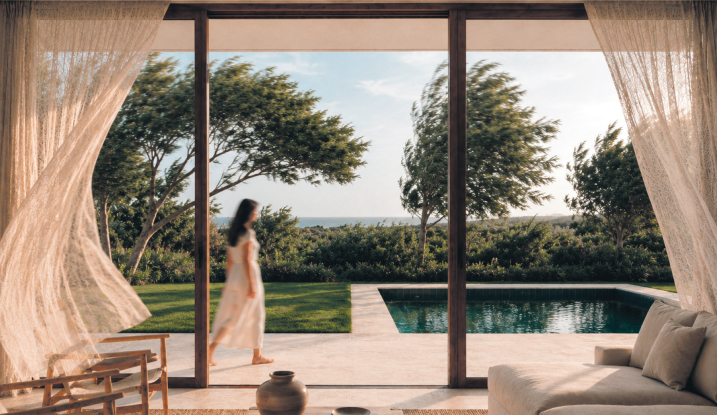
Consequently, many decisions that seemingly serve purely aesthetic criteria actually have a deep-seated climatic purpose. The orientation of a porch, the positioning of a terrace, the layout of a courtyard, the location of a swimming pool, or the choice of vegetation all seek to create sheltered spaces when the wind is at its fiercest, and open areas to catch the more favorable breezes.
Quality architecture is not about imposing oneself on the environment, but about understanding and embracing it. A home well-adapted to the climate offers greater well-being, consumes less energy, and ages more gracefully over the years. These are aspects that rarely catch the eye at first glance, but are felt every single day in the way a home is lived in.
Because the wind, too, is part of the blueprint. Even if it never appears drawn on a plan, it is present on the terrace that can be enjoyed year-round, in the garden that shelters from the mugginess of the Levante, or in the breeze flowing through the house on a summer afternoon. And that ability to converse with the environment is, perhaps, one of the greatest virtues of good architecture.
Article previous published in SGPlus.es magazine.